Even during the war, Arsenal, along with many other clubs, were getting regular requests to play matches abroad, many of which were turned down for obvious reasons.
On 12th August 1945, as peace started to come to Europe, Arsenal responded to a request that they just couldn’t turn down, to play a game against the British Land Army combined services XI in Dusseldorf, Germany.
This souvenir programme from the game was signed by the complete Arsenal side including the great Stan Mortensen. Oddly, it only lists 10 players on the side of the British Land Army…
Footage still exists of the match, which Arsenal won 6 – 1.
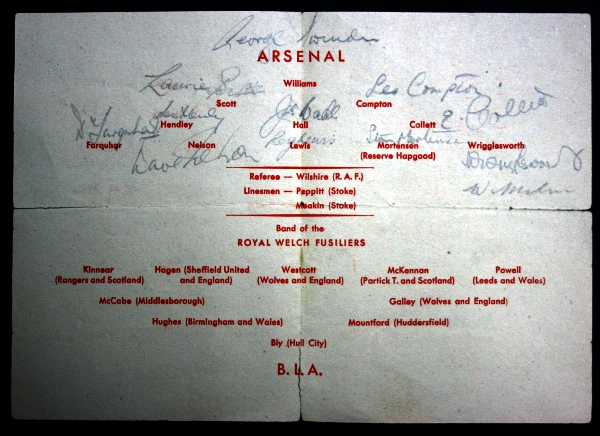
Thanks to Ian Nannestad of Soccer History Magazine, who provided some further useful information on this item:
“Hi
I saw this programme on your website and thought I would add some further information.
After VE Day (8 May 1945) there were large numbers of British troops in the British Zone of occupied Germany. They were not supposed to fraternise with German citizens and sports fixtures with organised German teams were banned (presumably for fear of providing a rallying point for German nationalists).
To entertain the troops the FA (as the organising body) arranged a series of matches between British club sides and military teams (nominally the BAOR, but team titles varied) which ran from July to November 1945 and again from March to June 1946. As far as I am aware entry was restricted to allied military personnel rather than the general population.
Arsenal were the third in the sequence of visiting teams, following on from Liverpool and Derby County. The match therefore is not in the tradition of Arsenal being invited to play in matches abroad, but rather in that of the military authorities holding top class football matches to entertain the troops (as, for example, with the touring teams led by Tommy Walker which visited the Indian Subcontinent).
This programme is for British Land Army vs. Arsenal, the connection of the Royal Welch Fusiliers is merely that they provided the band to entertain spectators.
Hope this is helpful to you.
Best wishes
Ian Nannestad
Soccer History Magazine
www.soccer-history.co.uk“


